Munich Agreement and dismemberment of Czechoslovakia
The Glass RoomThe Munich Agreement and dismemberment of Czechoslovakia mark the destruction of a country through a process presented as diplomacy rather than open battle. A radio broadcast offers assurances that territorial transfer can be arranged fairly and that Germany’s claims will end with the Sudeten question; the events that follow expose the cost of those assurances. In the novel, a family’s close listening gives way to a stark national reckoning: Czechoslovakia is partitioned, its army stands down, and refugees crowd the roads and trains as the republic disappears.
The Broadcast and Its Promises
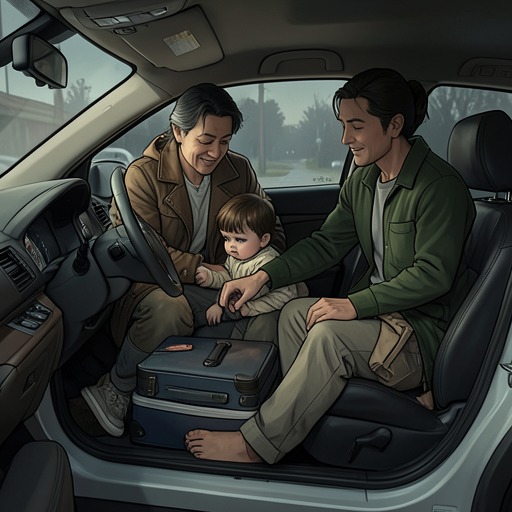
Liesel, Hana, Oskar, and Viktor listen as a voice on the radio describes the responsibility of leaders who have read letters about the crisis. The speaker says that it is horrible that people should be digging trenches and trying on gas masks over a quarrel in a distant country whose people are unknown to them. The statement recognizes the fearful preparations for war, yet its framing also places the threatened country at a distance, as an issue concerning people elsewhere.
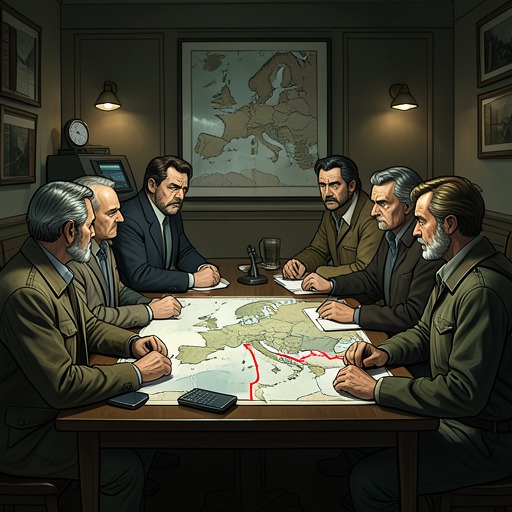
The broadcast argues that the dispute is already settled in principle and that the transfer of territory agreed to by the Czech government should be arranged by agreement, with fair treatment for the population concerned. It invokes the speaker’s talks with Hitler and presents his desire to champion other Germans as something that can be accommodated through negotiation. The promise that the Sudeten German question will be Germany’s final territorial claim in Europe sharpens the gap between reassurance and danger: the listeners are being asked to trust the assurances of the very settlement that places their country’s territory at stake.
The voice then weighs sympathy for a small nation against the prospect of involving the whole British Empire in war. For the people listening, the speech’s measured language does not make the danger abstract. Hana cries out in disbelief and asks for the radio to be turned off. Liesel remains still; Viktor eventually reaches for the set, but Hana urges him to wait. Their brief argument over whether to hear the rest of the broadcast gives the political crisis a domestic scale: they cannot alter the decision, but they must listen as others explain why they will not intervene.
The Listeners’ Recognition
Viktor laughs at the claim that the Sudeten question will end Germany’s territorial demands, treating the reassurance as a conclusion already contradicted by events. He moves to turn off the radio, but Hana stops him long enough to hear the speaker’s explanation that sympathy for a small nation cannot, in every circumstance, justify involving the British Empire in war. When Viktor switches the set off, Hana names the implication directly: their country is the small issue, and its people are people whom the distant powers know nothing about.
Hana is in tears, and Oskar tries to comfort her by patting her shoulder, without stopping the tears. The scene distinguishes between being spoken about and being heard. The broadcast’s abstract language turns the threatened country into a problem of policy and scale; Hana’s response restores the immediate human meaning of that distance. Her insistence that the listeners themselves are the people treated as insignificant makes the political decision personal without suggesting that their distress can change it.
The Country Is Dismembered
The narration shifts from the radio room to an explicit comparison between two ways of dismembering a body: the controlled, methodical work of a surgeon and the uncontrolled violence of a mad axeman. The extended analogy refuses to let the political word “dismemberment” remain a bloodless figure of speech. Whichever method is used, the result is the same: a body divided. The narrative applies that logic to the country’s loss of territory, describing the Great Powers as witnesses to the cutting away of its parts.
Czechoslovakia’s army stands down as troops in field grey enter Eger, Karlsbad, Teplitz, and Liberec. The sequence makes clear that the country is not simply threatened with a future invasion: its territorial losses are already being enacted while its army watches. The image of a vulture taking an eye accompanies Poland’s seizure of part of Czech Silesia, while Hungary takes parts of Slovakia. The different actions are presented as components of a wider partition, not as isolated border changes.
Refugees and the End of the Republic
As soldiers advance, refugees flee along roads and across fields, pushing handcarts or carrying bundles. Trains are packed and roads crowded. The account calls this the effect of war without the fighting, a rehearsal for what is to come. The phrase captures the contradiction of the moment: the country is already undergoing the dislocation and displacement associated with war, though the passage describes no battle. The transfers negotiated by governments become visible in the movement of people forced to leave their homes.
By the end of autumn, the republic has lost so much territory that the narration depicts only a ruined trunk remaining. Czechoslovakia has ceased to exist; in its place, the text says, a hyphenated, hybrid state called CzechoSlovakia is born, destined to live only briefly. The closing contrast between a country supposedly preserved through agreement and a state reduced to a short-lived remnant gives the event its decisive outcome: diplomatic assurances have not secured the republic’s survival.
Historical Irony and Narrative Form
The passage links the broadcast’s cautious, conditional language with the material consequences that follow, so that each reassurance is measured against the partition. The promise that the Sudeten settlement will end territorial claims stands beside the entry of troops into named towns, the seizures by Poland and Hungary, and the flight of refugees. Rather than treating the agreement as a self-contained diplomatic episode, the narrative follows its consequences from political speech into ordinary life and the disappearance of the state.
The anatomical analogy makes the country’s division legible as a violent loss even when the process is described as orderly negotiation. Its two methods—the surgeon’s calculated procedure and the axeman’s frenzy—differ in manner but not in result. That distinction also reflects the passage’s treatment of diplomacy: a decision may be delivered in controlled language and presented as settlement, while its consequences remain the severing of a political body. The event’s final image is not a negotiated peace but a brief, diminished successor to a republic that has ceased to exist.